Pobierz prezentacje w formacie PDF
Miałem zaszczyt prezentować podczas drugiego kongresu online w Warszawie. Wkrótce będzie tu można pobrać zawartość dodatkowe materiały.
Pobierz prezentacje w formacie PDF
Miałem zaszczyt prezentować podczas drugiego kongresu online w Warszawie. Wkrótce będzie tu można pobrać zawartość dodatkowe materiały.
Google have introduced +1 in March, but the changes including Google+ were only released today. The recent development only confirmed the rumours that Google have been working on their own social network. But it’s much more than just another social networking tool and the changes will have significant implications for businesses.
Here are some of my thoughts on how these changes will impact businesses and not only those based in Jersey.
1) Businesses will need to be more social. 99% of businesses are already on Google and have their content regularly indexed by spiders, so now, like it or not, your website is part of the Google+ social network and any user can recommend your brand to their friends.
2) Alternative to business pages on Facebook – creating a business page on Facebook is a big ‘NO’ for many companies. But expanding your presence on Google will be less controversial, as most website content is already indexed by Google.
3) Website becoming even more important. Google+ and +1 fill the gap between websites and social networks. Improving users’ experience on your website could earn you personal recommendations and subsequently accelerate your marketing efforts.
4) Higher rankings on search engines (SEO implications) - Google will use +1 as social signals, just like external links in the past, but could be more important because they come from humans rather than websites. This could improve your organic search results.
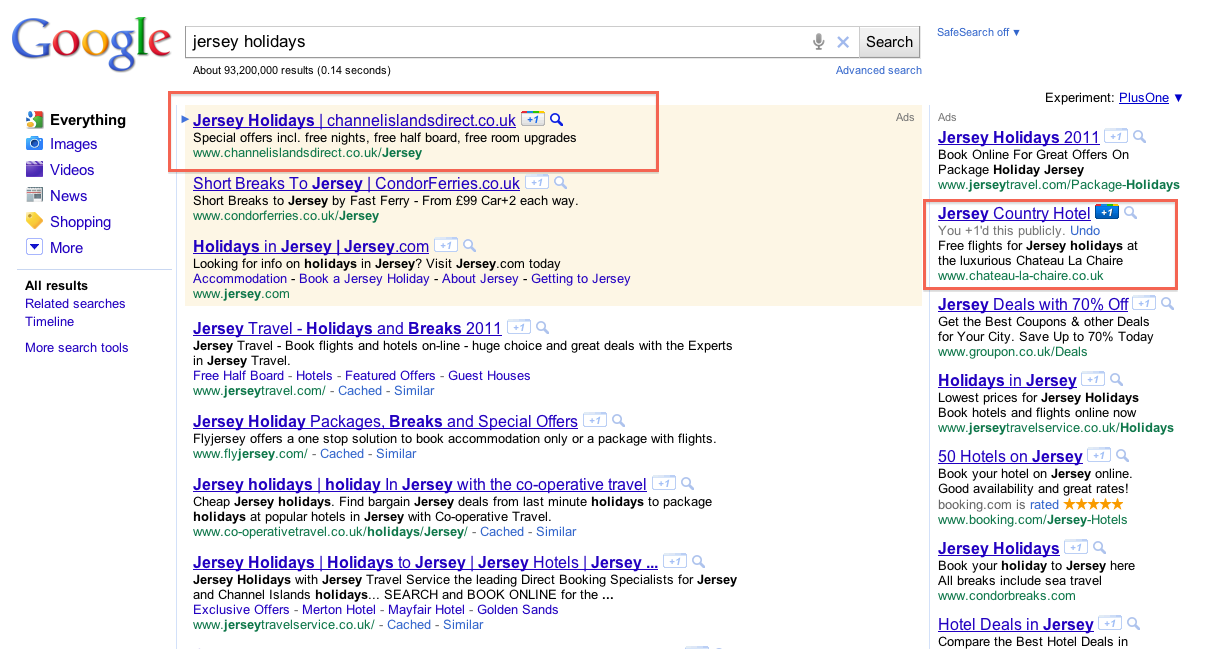
5) Improved CTR and conversions from your PPC ads. Advertising on Google could earn you social points +1s, personalised annotations that appear on ads after they’ve been +1’d should increase your ad performance.
ACTIONS
1 – Add +1 button to your website to encourage your website visitors to share your content.
2 – Create useful content. Review your website, add new pages, tools, video to encourage users to share.
3 – Advertise on Google. PPC ads could offer you a very cost effective way of earning personal recommendations, which will improve your performance on Google. As a business owner this is something you just can’t ignore.
ABOUT THE BOOK:
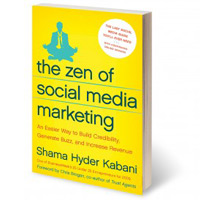
Title: The ZEN of social media marketing
Author: Shama Hyder Kabani
Target: Marketers, anyone responsible for companies’ social media efforts, small business owners.
KEY POINTS
- Great book if you are new to online marketing and social media. Shama’s book gives a practical overview of social media and its role in digital marketing strategy.
- The book concentrates on four main components of the social media infrastructure i.e. Facebook, Twitter, LinkedIn and Video. You will learn why/how to use them to make the most of your online marketing efforts.
- Even though the book is quite basic it contains plenty of tips and good advice. e.g. I enjoyed reading about social media marketing principles, etiquette, “shiny toy syndrome”, how to get more followers on Twitter, Twitter tips for writers and experts, leaders and non-profits.
- Chapter 8 “Creating a Social Media Policy” is useful and will help you create a social media policy in 10 simple steps.
- Video has become an integral part of social media and chapter 7 contains some practical tips on the basics of video production, how to monetise video content, and pros/cons of hosting on YouTube vs. own website.
HOT
- It was refreshing to hear from a social media consultant that the website is the best conversion tool and SEO is the cornerstone of any online marketing strategy: “Why a website? It’s expected! It’s efficient. It converts.” So many “gurus” are obsessed about social media and forget about the importance of having a good website.
- It’s difficult to create a strategy for something that is changing every second, but it was good to hear that a lot of companies lack a set in stone social media strategy, they only have have policies, rules and guidelines.
- It was interesting to read about Shama’s professional approach to Facebook. She looks at it as a business channel and keeps her profile, updates etc. very professional. This probably won’t work in my case – I don’t think my friends are really that interested in online marketing or my work!? But, definitely worth considering reviewing your Facebook profile and what information you are sharing with people who follow you on Facebook.
- It demonstrates how stories establish expertise, attract fresh consumers and help convert faster (e.g. testimonials, case studies, video interviews, audio interviews, pictures).
- There is a online version of the book, which is kept updated.
NOT
- “leverage” probably occurs more frequently in the book than “social”.
- Case studies at the back of the book are weak and high level. I was hoping to see statistics to back up the wonderful results the social media has contributed to.
- The book is very easy to read and written in a conversational tone, but sometimes it’s too basic e.g. I don’t see much value in giving very, very high level SEO tips such as write title and meta tags. It’s probably better to steer away from large topics that are not covered properly.
QUOTABLE 1: “The people who consistently do well using social media are the ones who were already doing well to begin with. The medium simply amplifies their success.”
QUOTABLE 2: “Don’t answer Twitter’s question (‘What are you doing?’) literally. No one really cares about the fact that you just brushed your teeth or have to go pick up the kids from school…”
QUOTABLE 3: Albert Einstein: “Everything that can be counted does not necessarily count; everything that counts cannot necessarily be counted.” – In this book, the quote is used in relation to measuring the social media.
ACTION/NEXT STEPS:
- I created my personal social media policy and now have much more disciplined approach to social media e.g. actions I will take daily/weekly/monthly.
- The book gave me some useful ideas for Twitter content and other blog posts.
- I need to experiment with LinkedIn Answers, apparently it’s great for business advice and market research.
CONCLUSION:
Firstly, the book is mainly for people who don’t know where to start with social media and need some initial guidance. So, if you already have more than a basic knowledge of social media and online marketing, the book probably won’t change how you do things. You can still benefit from some practical tips and advice though.
Secondly, the book is well written and you can’t ask for a more practical introduction to social media. If you are interested in this subject you’ll probably read it in a couple evenings.
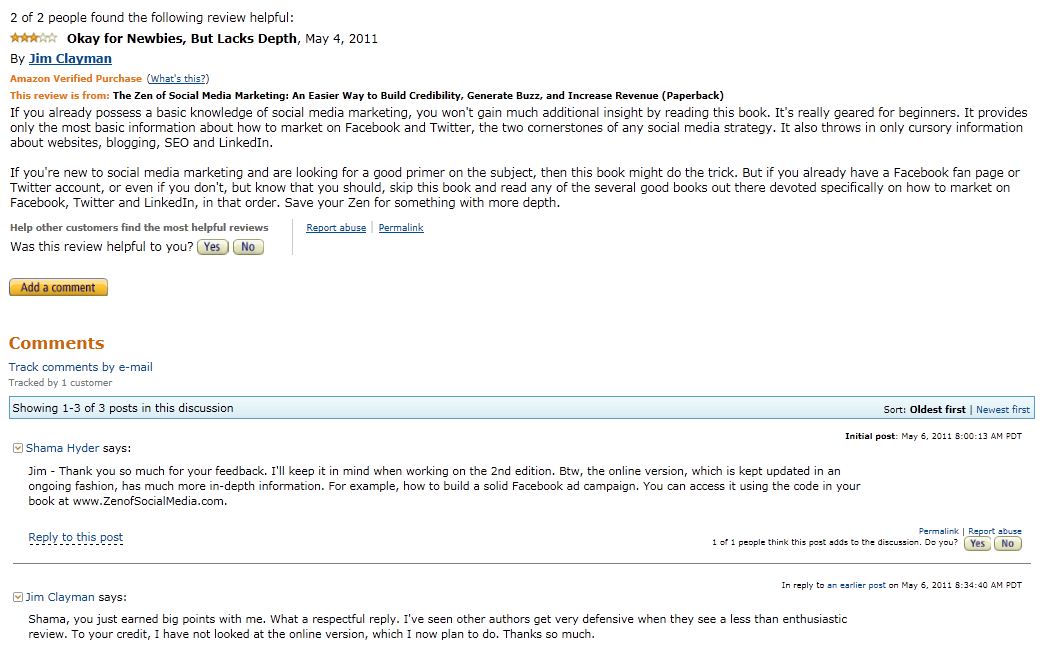
Finally, Shama puts the theory into practice, which is rare even for social media gurus! She not only responds to emails, tweets, but also knows how to respond to negative reviews on Amazon:

MY RATING: 9/10
Whilst Twitter is still working on an ad platform, and looking at the recent acquisition the ad platform won’t be available anytime soon, some users have decided to take things into their own hands.
Here’re some examples of sponsored messages and tweets.
Twitter definitely needs its own ad platform, one that will offer a cross between keyword/demographic targeting and will be easy to manage. The above attempts to monetize Twitter profile are very basic and remind me of the early days of link acqusition and paid links.
The concept itself could be lucrative for big Twitter accounts. It needs to be used carefully though, here’re some potential problems that could arise from selling tweets:
1) Users generally don’t like advertising on social media websites, i.e. selling tweets could reduce your number of followers.
2) Exclusive deals - Twitter is more personal than Display ads, endorsing one product could close the door on another deal.
3) Pricing - how much is a sponsored tweet worth? CPC needs to be much higher than PPC or Display – think of the price you could charge if someone wanted to place a link on your homepage for a day.
4) Limited data - you could track clicks and conversions but won’t be able to track impressions.
5) Limited ad space - “Sponsored message” is long and reducing the amount of space available for the promotional messages.
Any other potential issues worth considering before you decide to sell your tweetspace?
I’m not a big fan of Apple. But, sometimes you don’t have a choice – (Thanks J!), so now trying to make it work like my good old PC.
Here is a selection of keyboard shortucts (FYI – Mac users call them Quick-keys) that I use on a daily basis and allow me to be efficient on my MacBook Pro, almost as good as PC and Windows combo. Hopefully you will find it useful if you are migrating from PC to MacBook Pro.
1) Creating a folder in current view list-view not root directory without touching the mouse.
Step 1: With enclosing folder highlighted, type command-O. (The Finder view changes.)
Step 2: Type command-shift-N to create a new folder.
Step 3: Type the name of the folder followed by Enter or Return.
Step 4: Type command-[ to return to the previous Finder view.
Source: MAC OS X Hints.
2) Show desktop: fn + F11
3) Edit the web adress in any internet browser: cmd + l
works in Firefox, Chrome and Safari.
4) Navigate/switch between the windows of the same application (e.g. when you have more than one Firefox windows opened): cmd+~
5) Select screen grab and save on desktop: cmd+shift+4
6) Select screen grab and copy to clipboard: cmd+shift++ctrl+4
7) Excel – add new line within a cell: alt+cmd+enter
8) Excel – cell format properties: cmd+1
9) Excel – edit cell: ctrl+u
10) Excel – toggle between Excel worksheets: haven’t found it yet!
11) Internet browser – toggle between tabs: alt+cmd+arrows (L or R)
12) Where’s the hashtag character? alt + 3
13) Where’s Page up/Page Down FN + Down/Up Arrow
14) useful screen capture shortcuts:
screen shot + crop CMD + Shift + 4
screen shot no crop CMD + Shift + 3
15) how to move to the menu bar (same as Alt +F on PC: Fn-Control-F2
16) how to disable horizontal scrolling (used to drive me nuts!)
Run this command in the terminal window and reconnect the mouse
defaults write com.apple.driver.AppleBluetoothMultitouch.mouse MouseHorizontalScroll -bool NO
Mar 24th, 2011 by luke in Digital Marketing, Local and small business
I always believed it was difficult to manage complex online campaigns with national or global reach and relatively big budget. I’ve gained most of my digital marketing experience working with blue-chip, established companies with strong brand awareness.
I joined E-scape in Sept 2010 and since then I have been managing a number of successful online campaigns on Google, Facebook, Twitter for local businesses in Jersey. I have to admit that the journey from large brand to small business marketing has been much more difficult then I thought it would be. I’ve learned an awful lot in since I joined and still learn something new every day.
Some of the things I discovered small businesses do extremely well and have been doing them for ages! I’ve tried to group these findings under logical headings and share the ones that could benefit those who manage big marketing budgets or marketing for blue-chip clients brands.
1) Scrutiny
Every business owner I met loves to get involved in marketing planning. No surprise there as it is their business and their own cash. They understand their business better than anyone else. As such all elements of the plan are questioned and scrutinised. There is no sign-off or multi-layered approval process. But, believe me their due diligence is extremely effective and not a single penny is wasted.
2) Micro optimisation and targeting
When it comes to local marketing activity all campaigns are extremely well targeted. As such the lead/sale conversion rates are higher when compared to large, nationals campaigns. A conversion rate lower than 5% is just not good enough. Try convincing any business owner to invest in online marketing when less than 1 in 20 clicks generate sales.
3) Naturally social
The strength of small businesses come from relationships and a large proportion of new business can be attributed to word of mouth. It is very natural for small business owners to directly connect with their customers, suppliers and potential customers. As such small businesses didn’t take long to embrace social media marketing. A lot of these businesses have been effectively using Twitter or Facebook without any complex policies or expensive strategies. It isn’t that difficult! If you want to know how to do it just have a word with one of them!
4) Multi channel tracking and attribution
Whilst working for a large bank I was very proud when we implemented a sophisticated multi-channel click to sale tracking system. As it was very innovative and new it has taken quite a long time to get it right. A couple of months later I moved to E-scape and had to design and deliver a PPC campaign for a small insurance company in Jersey. We quickly created a tracking solution, which links Google Analytics with the client’s back office platform so then they can match campaign clicks with leads, sales and even work out life time customer value. The implementation cost was tiny and seemed to be the only way forward for our client. Now, think how many big brands can accurately track and attribute clicks to sales?
5) No buzz words
Big brands love big agencies. There must be a degree of business BS and buzz words whenever big agencies are involved. These type of large agencies prove to be costly, I was always surprised how much some of these people are paid. They have the gift of smoothly incorporating all important buzzwords into conversations. Unfortunately, it has nothing to do with the actual results. Small business owners can’t afford to employ schmoozers. Not suprisingly, they are better off employing hard-working people & agencies with actual skills and desire to work.
6) Improvise, adapt, overcome
Small companies have the ability to change and adapt to changing marketing conditions at an incredible pace. No lengthy sign offs, no process obstacles and very little or no legal barriers. In large companies the process from the moment when the problem is identified to the implementation phase could take months sometimes longer. As such, it’s sometimes easier not to do it! In the meantime small businesses benefit from the most recent technology, available tools, specialised niche agencies and more!
7) Creativity? Just do it
New ideas? Small businesses are not limited by the process, compliance or approvals. Many good ideas in a corporate environment end up in the drawer. This is mainly due to the necessity for the innovators to provide a business case, go through lengthy approval process or/and convince many clueless people that it’s a good idea. This isn’t the case when speaking to small business owners. They tend to have more common sense and generally have eyes wide open to new ideas and give you full ownership of driving these ideas forward.
8) Cost per click counts
When your budget is £15 per day NOT £15k then your Cost Per Click suddenly has a more tangible impact on the actual click volume and sales. Once again, micro targeting and micro optimisation leads to finely targeted campaigns and excellent results.
9) Feedback and pressure
The easiest way to improve the efficiency of your marketing spend is to get the marketing managers to chip in with their own money to the marketing budget or at least pay for their mistakes. Small businesses put an enormous amount of pressure on campaign managers and give constant feedback on the results. There isn’t much room for mistakes or wastage.
10) Power in simplicity
No schmoozing, no buzz words, pure skill and hard work generally leads to cost effective solutions. Small businesses have a lot of common sense and agencies don’t need to waste time trying to impress them. If you can’t put your idea in simple terms and present in less than 30 seconds it is unlikely to work and even less likely to get the client excited.
Conclusion
Not a great surprise that small companies are more efficient, nimble and innovative. Of course there are things they can learn from big brands too, particularly in relation to applying best practice and generally “doing things properly”.
I strongly believe that small and swift changes are the key to achieving high efficiency in any form of digital activity. This is how small businesses operate, add social media marketing to the mix and you will have a very successful marketing campaign. Big brands with their multi million marketing budgets can only dream of similar results.
What do you think? Agree/disagree? Any observations that I missed? Look forward to your comments.
Searching Google from Jersey, Channel Islands could be frustrating. Take a look at the examples below:
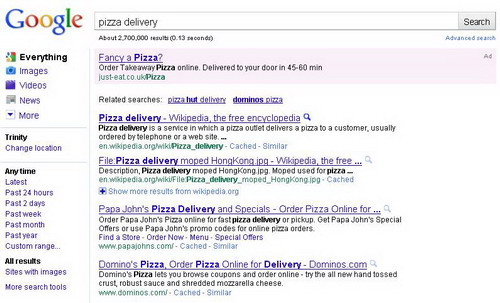
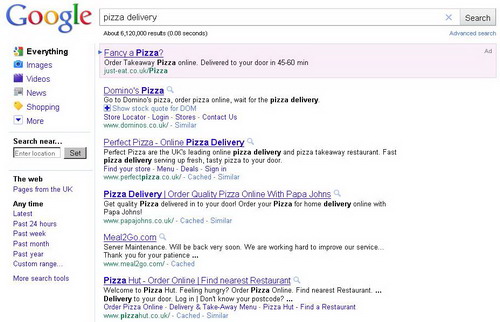
Even on Google.je Google struggles to differentiate between New Jersey, US and Jersey, CI. As you can see in the screenshot below Google thinks that Papa John’s or Domino’s are available in Jersey, Channel Islands. Island’s local restaurants such as Pizza Quarter or La cantina don’t even appear on page 1. There are things these businesses could do to improve their visibility on Google to ensure search engine users could find them. But, let’s just concentrate on user experience for a while and see what searchers could do to find local results on Google.
Similar situation when searching ‘pizza delivery’ on Google.co.uk, Google returns lots of irrelevant results.

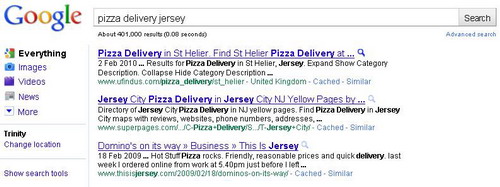
Let’s see what happens if we add Jersey and search google.je. The number one result is correct, but position number two is occupied by a New Jersey restaurant.

This issue isn’t only related to local restaurants, similar problems occur when searching for hotels, jobs, real estate agents, plumbers etc.
Although you can’t change or improve Google’s algorithm to make the search results more relevant you can refine your search queries to filter out irrelevant results. Here’re 6 simple tricks I’ve been using since I arrived in Jersey and they will definitely make your search results more accurate.
1) Add -NJ to your search query, Americans often add New Jersey acronym to the address, -NJ will get rid of everything with NJ.
2) Add -city, quite a lot of results return businesses based in Jersey City.
3) Add -new this is another negative search term, will effectively remove everything including -new i.e. New Jersey etc. Of course keep in mind that if you are looking for a new car you shouldn’t use -new as a negative keyword.
4) Include Jersey – adding the location name is always a good idea when searching for a local business.
5) Include St Helier or another parish if you know where the business is based.
6) And finally for local results avoid using Google.com always start from Google.je or Google.co.uk they are more likely to return local results.
Any other tips? If you have any other clever ways of refining search results on Google please let me know and we’ll add it to the list.
ABOUT THE BOOK:
Title: Marketing in the Age of Google: Your Online Strategy IS Your Business Strategy
Author: Vannessa Fox
Target: corporate executives, organic search for non-search audience
KEY POINTS:
- Useful overview of Google Trends and Google Insights for Search.
- Keyword categorisation e.g. brand, product reference, other etc. e.g. San Diego B&B could have three main keyword groups brand, wine reference, things to do.
- Checklist for Hiring an In-House SEO and Hiring an Organic Search Agency.
- Search acquisition strategy process, loving the framework.
- Understanding query types and their part in the content strategy.
STATS:
- Jupiter Research: 36% of those surveyed felt that “…seeing a company listed among the top results on a search engine makes me think that the company is a top one within its field…”.
- iProspect Search Engine User Behavior white paper : 62% of searchers click a result on the first page of results and 90% click within the first three pages.
- Enquiro Research: when searchers were asked if they remembered seeing brands in the search results, fewer than 30% did if the brand was only in a paid search ad, but nearly 60% did when the brand appeared on top of both paid and organic.
HOT:
- Personas – the concept of providing snapshots of your potential customers at different phases of the buying cycle, including demographic data, different search query categories and different journeys (called conversion workflows). In other words, searcher goal, searcher queries, task completion, business goals, searcher motivated to convert by [e.g. price].
- Of course it’s not the focus of this book but still I thought Vanessa gave some tips for getting started with social media.
- Honest and authentic perspective on search from a experienced ex-Googler.
NOT:
– Perhaps Vanessa is too passionate about search and sometimes I thought she doesn’t recognise the importance of other marketing channels or doesn’t provide the reader with an alternative, non-search perspective. As a result some of the case studies or tips are not very practical.
- Some of the messages are inconsistent e.g. one paragraph is tells you ‘not to focus too much on SEO but on what the search engines are trying to achieve’. I think I understand what Vanessa is trying to say, but equally it could be confusing.
– Generalisation, e.g. in the Preface Vanessa attempts to put all businesses into three categories: 1) don’t know where to start with SEM 2) don’t think SEM is important 3) obsessed with positions and rankings and don’t have strategy. What about businesses that have been doing SEM for years?
- Internationalization of search is mentioned briefly and it’s disappointing that not more information was provided.
QUOTABLE 1:
“not participating in the conversation is a loud statement of its own to your customer base. You can’t control your branding message in any case because your customers are already talking about you online. The best you can do its to participate.”
QUOTABLE 2:
“…unrealistic to think commercial content to rank well for information research queries.”
ACTION/NEXT STEPS:
- I now follow Vanessa Fox and would recommend her book to my clients, some of her definitions and tips could help when speaking to non-technical audience
- take a look at the Google leaked quality guidelines doc
- note to myself!…new blog ideas: involving Jersey, universal search, personas, how to search tips.
CONCLUSION:
Great book demonstrates that SEO is not only about positions and rankings. If only all senior executives and business owners read the book our lives as search consultants would have been so much easier! I certainly found it useful, learned something new and would definitely recommend this book to everyone working in sales, pr, marketing & research.
MY RATING: 7/10
You can get it on Amazon:Marketing in the Age of Google: Your Online Strategy IS Your Business Strategy
I love the idea of reading lists but my reading habits are usually quite spontaneous – meaning I often lose track of what I read and when. Eliza’s reading list inspired me to create my own for 2011. My goal for this year will be to read at least 1 book each month.
Why I can’t read novels?
I recently found a good explanation why some people can’t read novels, I can relate to most of the reasons. I don’t read fiction, I’ve been allergic to novels since I left high school. In fact it makes my life easier as I only get to read technical & business books now, Yay!!!
Here’s my reading list for 2011:
1) Ogilvy on Advertising by David Oglivy – View on Amazon
2) Can I Change Your Mind?: The Craft and Art of Persuasive Writing by Lindsay Camp - View on Amazon
3) The Art of SEO (Theory in Practice (O’Reilly)) by Eric Enge – View on Amazon
4) Web Analytics 2.0: The Art of Online Accountability and Science of Customer Centricity by Avinash Kaushik – View on Amazon
5) Powerful Marketing On A Shoestring Budget: For Small Businesses by Dee Blick – View on Amazon
6) The Intelligent Investor: The Definitive Book on Value Investing. A Book of Practical Counsel by Benjamin Graham – View on Amazon
7) Emotional Capitalists: The New Leaders by Martyn Newman – View on Amazon
8) Write To Sell: The Ultimate Guide to Great Copywriting by Andy Maslen – View on Amazon
9) The Ultimate Competitive Advantage – Secrets of Continually Developing a More Profitable Business Model by Donald Mitchell – View on Amazon
10) Endless Referrals: Network Your Everyday Contacts Into Sales, New & Updated Edition by Bob Burg – View on Amazon
11) Absolut: Biography of a Bottle by Carl Hamilton – View on Amazon
12) Logo Design Love: A Guide to Creating Iconic Brand Identities by David Airey – View on Amazon
Bonus books
13) The Referral Engine: Teaching Your Business to Market Itself by John Jantsch – View on Amazon
14) The Zen of Social Media Marketing: An Easier Way to Build Credibility, Generate Buzz, and Increase Revenue by Shama Kabani – View on Amazon
15) Pull: The Power of the Semantic Web to Transform Your Business by David Siegel - View on Amazon
16) Get Seen: Online Video Secrets to Building Your Business by Steve Garfield – View on Amazon
17) Wired for Thought: How the Brain Is Shaping the Future of the Internet by Jeffrey M. Stibel – View on Amazon
18) Rework by Jason Fried – View on Amazon
In bold - books that I finished reading.